Study: Social Determinants of Health Are Associated with Early Identification of Premature Mortality Risk
A new study presented by Socially Determined at ISPOR 2026 quantifies what many in population health have long suspected: a person’s social determinants of health (SDOH) burden predict not just whether they die prematurely, but by how much earlier.
How the Study Came Together
Researchers at Socially Determined linked their person-level SDOH risk scores to Veritas’s Fact of Death (FOD) and Cause of Death (COD) mortality data. The FOD Index consolidates more than 45,000 mortality sources, including government registries, memorial records, and interment records, into a single de-identified record per individual. The Cause of Death solution maps each FOD record to a primary cause and contributing comorbidities using clinical real-world data.
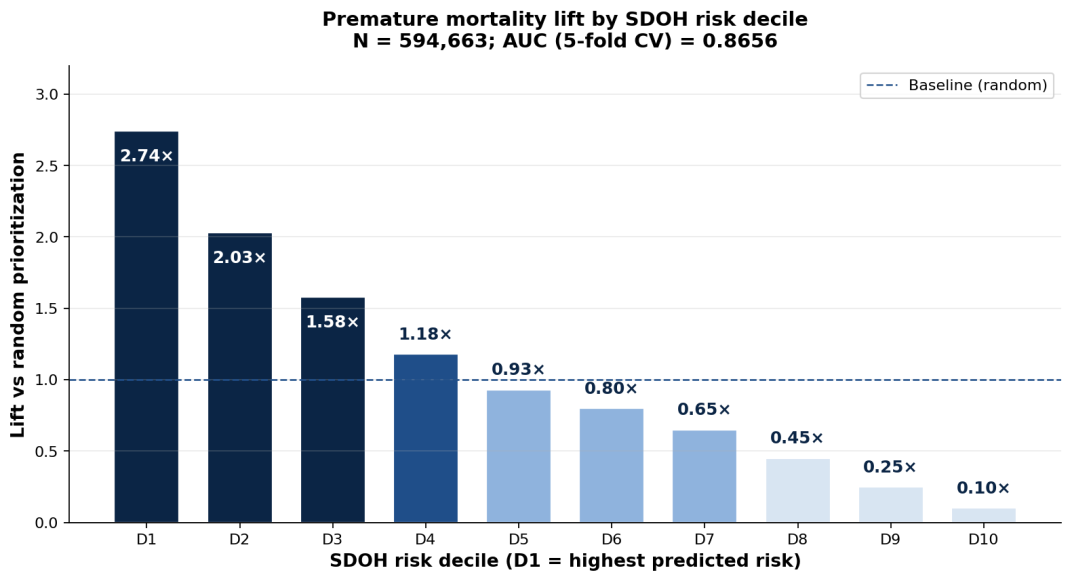
After linkage of the two data sets through privacy-preserving tokenization, the analytic cohort included 594,663 individuals across Florida, Maryland, Virginia, West Virginia, and Washington, DC. Each individual record contained SDOH risk scores across five domains alongside verified age at death and cause of death.
What the Study Found
The headline result: individuals in the highest SDOH risk decile had 2.7 times more premature deaths (defined as death before age 75) than expected under random prioritization. The top 20% of the SDOH-ranked cohort accounted for roughly half of all premature deaths in the sample.
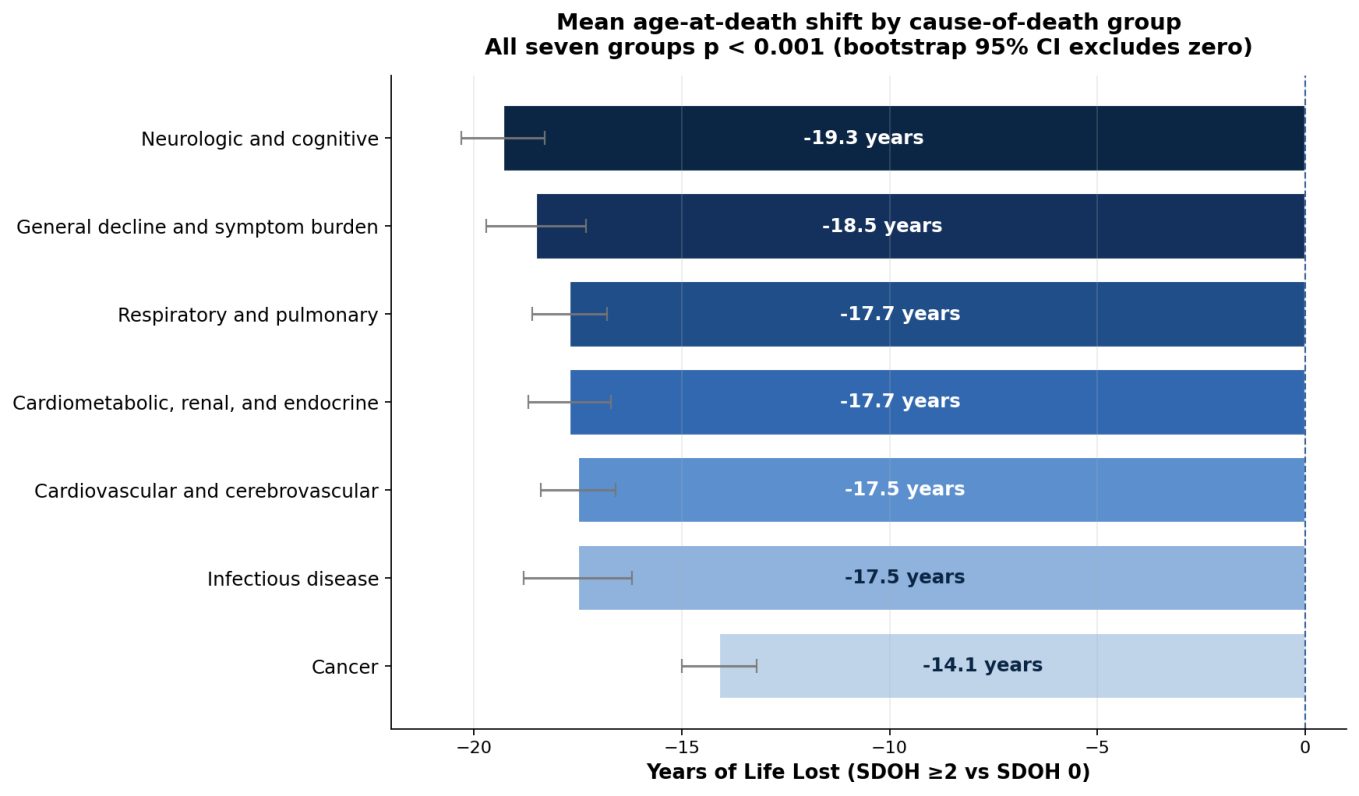
Across every major cause-of-death category, people with high SDOH burden died substantially earlier than those with low burden. The additional number of years of life lost ranged from 14 to 19 years depending on cause of death and held consistently across all 27 ICD-coded primary diagnoses examined.
Why Mortality Data Quality Matters In Outcomes Analyses
Studies like this one depend on mortality data that is accurate, timely, and linkable. A mortality record that arrives months late, misidentifies an individual, or cannot be joined to a third-party data source through a shared token cannot support critical outcomes analyses.
The Veritas FOD Index is aggregated across 45,000+ sources, and contains deaths that no single registry surfaces on its own. Deterministic deduplication triangulates duplicate death notices into a single authoritative record. Implications for Payers, Population Health, and HEOR
An SDOH-based risk framework built on reliable mortality data can identify individuals at elevated risk of premature death before clinical disease has fully manifested in claims or EHR data. For payers and population health teams, that is a meaningful window for earlier intervention.
The study also provides empirical grounding for prevention Return on Investment (ROI) modeling. High SDOH burden associated with 14 to 19 years of additional life lost across leading causes of death gives upstream social-risk investment a mortality-endpoint base of evidence to stand on.
The full ISPOR 2026 extended handout, including full methodology, all figures, and complete results, is available to download below.
Interested in how Veritas mortality data can support your research or population health programs? Contact us.