For most research applications, mortality data timeliness is treated as a secondary concern. Coverage and accuracy get all the attention and timeliness gets a note in the methods section.
Our new study shows that this priority order deserves a second look.
The lag problem
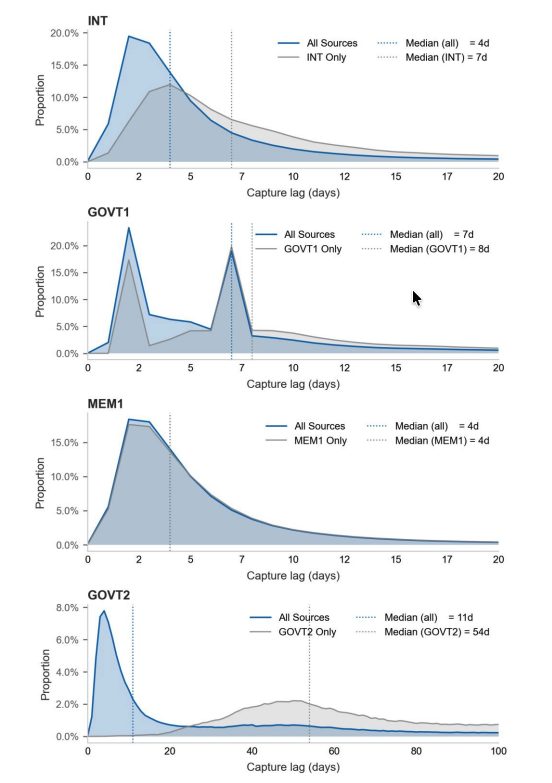
Reporting lag, the number of days between a death event and its appearance in a database, varies significantly by source type. Government administrative sources are structured and accurate, but they run through bureaucratic reporting pipelines. One source category examined in the study shows a median capture lag of 54 days. That means half of deaths haven’t appeared in the database for nearly two months.
For pharmacovigilance, longitudinal cohort monitoring, and any analysis requiring near-real-time mortality status, 54 days is a substantial gap.
Where memorial sources change the picture
Obituaries and online memorial platforms publish death information quickly, often within days of occurrence. The study finds that for deaths occurring after January 1, 2024, consolidation paths starting from the slowest administrative source and adding memorial sources reduce median lag from 54 days to 11 days. For databases starting from interment-based sources, adding memorial data shifts the median from 7 days to 4 days.
The percentage of deaths captured within 14 days follows the same pattern. Paths starting from GOVT2 sources see a 35 percentage point improvement in 14-day capture rate when memorial sources are added. Paths already starting from memorial sources show little additional gain, because timeliness was already strong.
Why the starting source matters
One of the study’s more practically useful findings is that improvement magnitude depends heavily on where you start. If your existing database relies on administrative sources with slow reporting pipelines, adding memorial data produces dramatic timeliness gains. If you’re already anchored to a memorial-first source, the coverage and completeness improvements that come from adding government and interment sources become the priority.
This means timeliness strategy and source selection are connected decisions, not independent ones.
The research implications
Delayed mortality capture affects more than reporting timelines. Studies that analyze time-to-event outcomes, monitor active patient cohorts, or support ongoing pharmacovigilance require current data. When deaths appear in the database weeks late, event timing is misattributed, follow-up periods are miscalculated, and safety signals can be delayed.
A composite database built across government, interment, and memorial sources addresses this directly. The study demonstrates that regardless of starting source, timeliness improves at each stage of consolidation, and the full composite database performs meaningfully better than any single-source alternative.